The gut needs 7–14 days.
Stomach pH, enzyme production, and gut bacteria all re-tune for raw protein. Rush it and you'll see loose stool that has nothing to do with whether raw "works." Go slowly and the stomach adjusts quietly in the background.
$0.00 USD
You noticed. You're right to notice. And there's a reason — one that matters more than a taste test ever could.
A taste test tells you if your pet likes it. A transition tells you if it works.
Most "trial" pet food boxes ship you two or three meals. Just enough to see if your pet will take a bite. We could do that too — it would be cheaper for us to send, and easier for you to say yes to.
But here's the thing: switching your pet to raw food is not a taste test. It's a transition. Their gut flora has to adjust. Their stool settles. Their energy shifts. None of that shows up in three meals.
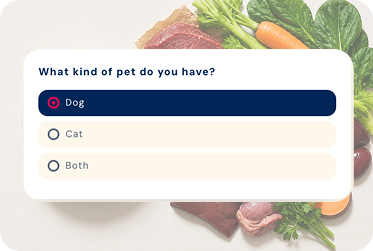
So we sized your first box around how raw actually works — enough food to walk your pet through a proper 10-day transition, gradually, the way a vet or a raw-feeding expert would tell you to do it. And because every pet is different, we use a short quiz to send your pet's amount — not a one-size-fits-all box.
Going raw is a real physiological shift. Your pet's body is switching from carbohydrate-heavy fuel to protein and natural fats. That takes more than a few meals to settle.
Stomach pH, enzyme production, and gut bacteria all re-tune for raw protein. Rush it and you'll see loose stool that has nothing to do with whether raw "works." Go slowly and the stomach adjusts quietly in the background.
Our 10-day transition starts with 25% Darwin's mixed with 75% of your pet's old food. Every three days the ratio shifts — 50/50, then 75/25, then fully on Darwin's. That arithmetic is what the box is sized around.
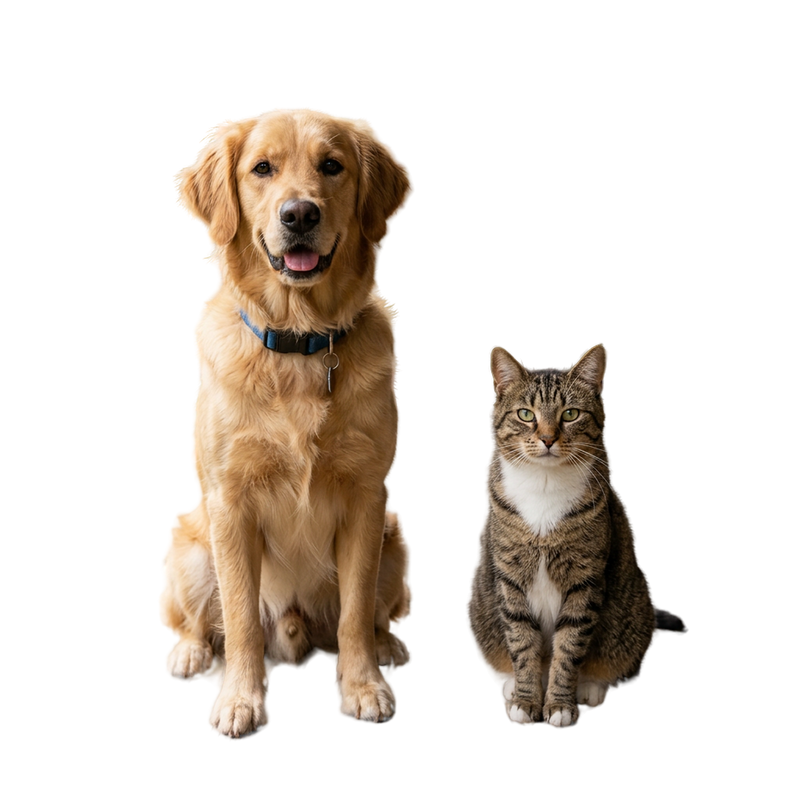
A 9-pound cat and a 70-pound retriever don't need the same trial. Our quiz calculates what your pet specifically needs for a full transition — weight, species, life stage, activity — and that's what ships.
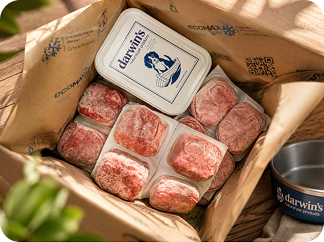
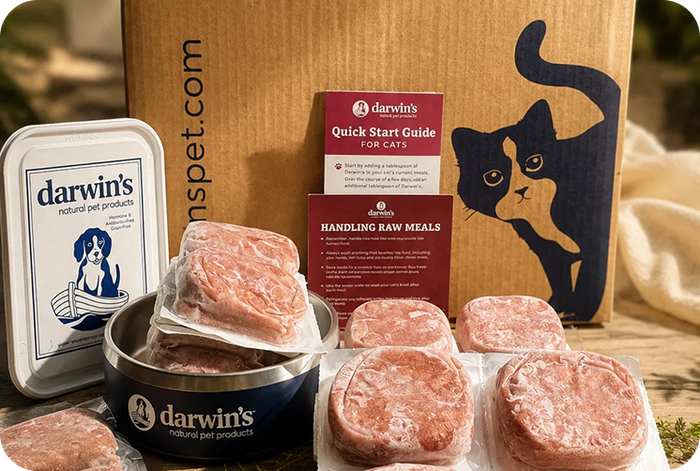
Pre-portioned pouches of Darwin's — calculated for your pet's weight and the full 10-day transition. Plus a transition guide that walks you through exactly how to introduce each day's mix. Everything arrives frozen, packed with dry ice, ready to go straight into your freezer.
Tap any day to see exactly what happens. Switch between dog and cat — the rhythm is similar but cats take their time.
That's why your first box has what it does — enough food to actually do this the right way.
Get my pet's amountDogs adjust to raw faster than cats, but the gut still needs time. The 25 → 50 → 75 → 100 mix is what keeps stool firm and energy steady while the switch happens.
Cats often refuse new food on the first try, or the second. A proper transition gives them time to come around — and it needs more food than a taste-test would suggest, precisely because they're slower.
So we don't send a 50-pound Lab's box.
Answer a few questions about your pet — species, weight, age, activity — and we'll calculate the exact amount needed for a proper 10-day transition. Your first box ships at 50% off.
Pulled from our verified Trustpilot reviews — the ones that describe the actual switch, not just the end result.
"I was worried the first box was too much food. Two weeks later I realized it was exactly the right amount — and I was already placing my next order."
The questions pet parents actually ask before hitting "start the quiz." More in our full FAQ.
It depends on your pet. The quiz calculates your pet's daily portion (typically 2–3% of body weight for dogs, 2–4% for cats) and multiplies it across the 10-day transition, factoring in the mix ratios. A 10-pound cat receives far less than a 70-pound retriever — we don't send a generic box.
For most dogs, about 10 days following a 25 → 50 → 75 → 100 rhythm. For cats, plan on 2–4 weeks and sometimes longer — cats are naturally more cautious about new food and should never be rushed. Our dog transition guide and cat transition guide walk through each step.
Common — and usually temporary. Try serving at room temperature (cats don't love cold food), hand-feeding a small amount, or mixing a spoonful of their current food on top for familiarity. Gently warming the food releases aroma that many cats respond to. Never let a cat go more than 24 hours without eating; the goal is gradual acceptance, not tough love.
Almost always there won't be — the portions are calculated for your pet — but if there is, it stores in the freezer for months. Many cat parents partially thaw a pouch, cut it into small daily portions, and refreeze the rest. Once fully defrosted, raw food keeps 3–4 days in the fridge, just like fresh meat.
Some younger, healthy dogs handle a direct switch fine. Most don't — and cats almost never do. The 10-day transition dramatically reduces the risk of loose stool, vomiting, or your pet rejecting the food before their gut has had a chance to adjust. It's the reason your box is sized the way it is.
Yes, Darwin's is a subscription — but completely flexible. Pause, adjust your delivery schedule, or cancel any time from your account. Your first box ships at 50% off as a new-customer offer.
Take the quiz, get your pet's exact amount, and start your transition for 50% off. We'll handle the math — you watch the difference show up in the bowl, the energy, and the coat.